
Read Coffee County Property Tax Records by Office
Two offices do the tax work in Coffee County. The Board of Tax Assessors appraises parcels, keeps the assessment roll, and rules on exemptions and appeals. The Tax Commissioner sends the bill and collects it. A careful property search keeps three items separate: the assessment notice, the QPublic parcel card, and the live tax account. The official 2024 notice says it is not a tax bill and lists the 100 percent appraised value beside the 40 percent assessed figure Georgia taxes. Keep those two columns separate.
| Field | What It Shows | Where |
|---|---|---|
| Appraised or fair-market value | Full assessment estimate for the stated year | Board of Tax Assessors |
| Assessed value | Generally 40 percent of the appraised value before applicable adjustments | Board of Tax Assessors |
| Exemptions and covenants | Homestead or other approved assessment treatment | Board of Tax Assessors |
| Bill and payment status | Amount billed, balance, payment, penalty, and interest as posted | Tax Commissioner |
| Tax district and millage | Jurisdictional rate context for the account | Assessment notice and tax office |
Neither figure is a sale price. A recorded deed or a PT-61 transfer form offers better price evidence, while a private appraisal answers a different valuation question.
Coffee's 2024 Notice Shows the Assessment Fields
The 2024 Coffee assessment notice is only a sample. It shows taxpayer and return details. It also lists property and account references, a tax district, prior and current value fields, exemption and covenant markers, estimated-tax figures, and appeal information. Note the tax year with every figure. Values from different assessment cycles should never be merged, since a prior figure and a current one can sit side by side on the same form.
| Property identity | Taxpayer name, return address, parcel or account reference, and property description |
|---|---|
| Value comparison | Prior and current appraised or fair-market figures and assessed value |
| Tax treatment | Exemptions, covenants, tax district, and net taxable values when shown |
| Review rights | Notice date, appeal deadline, grounds, and filing directions |
The live QPublic card uses different labels. Record exactly what the screen shows, and do not infer an update date the county has not published.
Coffee County Exemptions Begin with an April 1 Deadline
Coffee County's exemption filing deadline is April 1. The Assessor's material covers homestead, conservation use, preferential, historic-property, disabled-veteran, and Freeport programs. Eligibility rules differ by program. Start on the Coffee County exemption page, pull the current form, and ask which proof the Assessor requires. An exemption lowers net taxable value, not appraised value. Check which value the notice shows. A prior owner's exemption does not transfer automatically after a sale, so confirm its status before comparing figures.
Look Up a Coffee County Tax Bill in the Right Sequence
Begin in QPublic to find the parcel, owner label, situs, tax district, assessed value, and exemptions. That identifies the account. Then check the current bill through the Coffee County tax-payment site or the Tax Commissioner for balance, payment status, penalty, interest, and any collection status. Government Window, the processor, may charge a fee.
- Find the parcel in QPublic and copy its exact ID, owner label, situs, and tax district.
- Open the Tax Commissioner account for the same parcel and select the correct tax year.
- Record the bill date, due date, balance, payments, interest, penalties, and receipt details shown.
- If collection is at issue, request the tax fi fa, notice, release, or sale record from the proper custodian.
- Assessed value
- The portion derived from appraised value for tax calculation, subject to lawful adjustments.
- Millage
- A rate applied in the tax calculation by the relevant jurisdiction.
- Homestead exemption
- Approved relief for a qualifying owner-occupied home under current rules.
- Tax fi fa
- A collection instrument that may be recorded after unpaid taxes, not proof that a sale occurred.
December 1 Is Coffee's Stated Tax Due Date
Coffee's official tax FAQ puts the due date at December 1. Interest runs 1 percent per month after that. Unpaid taxes can draw a 10 percent penalty within 90 days, though certain homesteaded liability under $500 is excepted. The live bill still controls. Payments, releases, and dates change over time. Trust the local notice over a statewide summary. Record the bill's own due date, and contact the Tax Commissioner when anything conflicts.
Check Coffee's Published Tax Guidance
The Coffee County tax information page provides the captured local billing context.
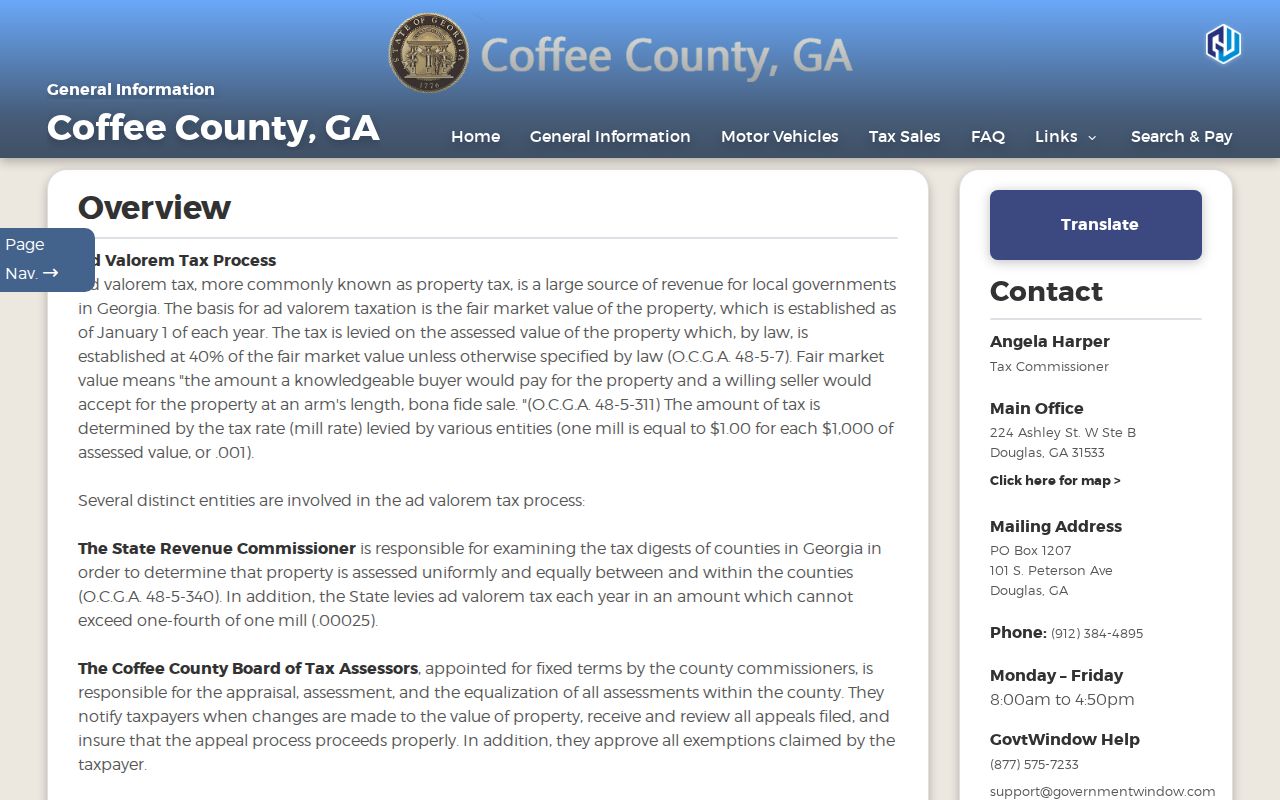
Use the FAQ page for the general process only. A live balance or deadline still depends on the current parcel account and confirmation from the office.
A Delinquent Coffee Account Is Not Automatically a Tax Sale
Unpaid taxes older than 30 days can trigger a tax fi fa recorded with the Clerk of Superior Court. That recording is one step, not the whole story. Delinquency follows a long sequence: assessment, bill, interest or penalty, possible fi fa, notice or advertising, possible sale, deed, then redemption or release. The county posts no official sale calendar. Verify the account with the Tax Commissioner first. Search the GSCCCA lien and real-estate systems as well. The official sale notice or a recorded release answers the rest. A delinquent label alone never means land is scheduled for sale. A tax deed does not settle redemption either.
A New Coffee Deed Can Appear Before the Tax Roll Updates
Coffee County's assessor, tax office, and clerk update on different schedules. QPublic may still name the seller. GSCCCA may show the buyer's deed recorded days ago, while a prior-year tax bill names the earlier taxpayer. Keep all three dates. Never pick one label quietly and discard the rest. For proof of ownership, read the latest deed plus any estate, tax, court, lien, or release papers, and ask the Tax Commissioner which account currently receives the bill.
Keep a Coffee County Tax Record Worksheet
Keep a worksheet for each Coffee County tax record. Log the parcel ID, situs, named taxpayer, tax year, and capture date. Add value label, exemption, bill status, and office. Note what the item is. A notice, property card, estimate, bill, receipt, fi fa, and release each carry different weight. An old bill is not proof of ownership. An estimate is not a posted balance. When figures conflict, give the Assessor the parcel ID and notice year for valuation questions. Give the Tax Commissioner the ID and bill year for balances, and give the clerk a party name, instrument type, and date for any fi fa or release.
Fair Market, Assessed, and Net Taxable Values Are Not Interchangeable
Coffee County assessment notices stack several numbers on one page. The fair-market figure reflects full appraised value. The assessed figure equals 40 percent of it. Exemptions and covenants then reduce the net taxable amount. Millage rates and jurisdiction drive the actual tax calculation. Many notices also print a prior-year column for easy comparison. Copy each label, year, and amount together. Otherwise you risk comparing a full value against a net taxable figure.
A recorded sale amount plays a different role. You can pull it from a deed image or the PT-61 filing. Yet sale terms can distort any simple comparison. Want a closer look at what each label means? The Coffee County property-value guide walks through them. Here the values matter because they feed the assessment and the property tax records. They do not predict the next sale.
Coffee County Assessment and Payment Channels Cover Different Failures
QPublic sometimes fails to return a parcel. When that happens, contact the Board of Tax Assessors with the situs address, owner name, legal description, and any older parcel number. Ask for the current property card, notice, map reference, exemption status, and update date. The assessor explains assessment fields. The office cannot certify a payment posted.
Payment problems belong to the Tax Commissioner. Call with the parcel or account number and the tax year in question. Request the current bill or ledger, payment status, a receipt, penalty and interest detail, and any collection referral. For a recorded fi fa or release, use the Coffee County Clerk and GSCCCA index. Other non-exempt records have another route. A Georgia Open Records Act request can name the exact record, dates, format, and a cost estimate.
City Tax Context Still Begins with the Coffee Parcel
A city mailing line proves little by itself. A parcel may carry a Douglas, Nicholls, Broxton, or Ambrose address. It may still sit outside that city. Boundaries must be checked. Confirm the tax district against current assessment and planning records before assuming any municipal status. City millage figures add context. The Douglas economic-development office shows this. No city figure belongs to a parcel based on its postal city alone.
Near a city edge, extra care pays off. Ask the Assessor to confirm the district. City planning can confirm annexation or municipal status as of a stated date. Annexation can change service and tax context while the deed remains a Coffee County recording.
File a Coffee County Assessment Appeal on Time
The appeal window runs 45 days from the notice date. Value, uniformity, taxability, and exemption denial all qualify as grounds. Follow the current notice. File with the Board of Tax Assessors by its stated deadline. Keep proof of delivery. Identify the parcel, tax year, disputed ground, requested correction, and supporting records.
Strong evidence includes the notice, property-card errors, and deed and plat descriptions. Photographs and comparable assessment records can also help. A professional appraisal may be warranted in some cases. The Board of Equalization is one route. Remember, the appeal challenges the assessment, not a Tax Commissioner payment posting.
Appeal window. Count 45 days from the Coffee County notice date and use the filing directions on that notice. A late submission can forfeit review for that cycle.