
Read Coffee County Deed Records by Instrument Type
Every Coffee County property search for deeds starts with the instrument itself. It does not start with the assessor tax card. The deed image names the parties. It gives the recording date. It spells out the legal description and cites the book and page. It may also carry reservations, easements, prior references, signatures, and capacity. The Coffee County Clerk of Superior Court keeps the books. GSCCCA supplies the online index. Begin with the newest likely vesting deed, read the image, and follow its citations. The assessor owner label is a helpful lead. Still, only the recorded conveyance proves who holds title.
| Deed Type | What It Does | Common Use |
|---|---|---|
| Warranty deed | Conveyance with stated title covenants | Ordinary sale or transfer |
| Quitclaim deed | Transfers the grantor's stated interest | Family transfer or title cleanup |
| Limited warranty deed | Conveyance with limited covenants | Some sales and entity transfers |
| Executor or administrator deed | Transfer made in an estate capacity | Probate sale or distribution |
| Tax deed | Instrument following a tax-sale process | Must be read with notice, redemption, and later records |
A security deed, lien, release, plat, or PT-61 filing often sits beside a conveyance. Each answers a different question. A deed records a transfer. An encumbrance burdens an interest. A release may show why an old lien no longer binds the land. Read the label and the full image before deciding what a document means.
Search Coffee Names and Book References Online
The GSCCCA real-estate name index lets you narrow by county, date, party name, party type, instrument type, and neighboring counties. Image access is built in. Set Coffee as the county. Search the current owner as grantee first. Inspect the deed, then run its grantor as a grantee over an earlier date range. Initials, married-name variants, entity suffixes, trustees, and estate labels can split one chain across several results. Expect to test each form of the name.
| Index field | Use in a Coffee search | Risk to note |
|---|---|---|
| County and date | Limit results to Coffee and the likely transfer period | The published system window is not a guarantee of complete county coverage |
| Party and role | Search a name as grantor and grantee separately | Names and capacities vary |
| Instrument type | Separate deeds from liens, releases, and other filings | Misclassification or indexing variation can occur |
| Book and page | Retrieve a known reference directly | The image must still be read |
See the Coffee County Deed Name Form
The official GSCCCA name-search page is the source for this captured form.
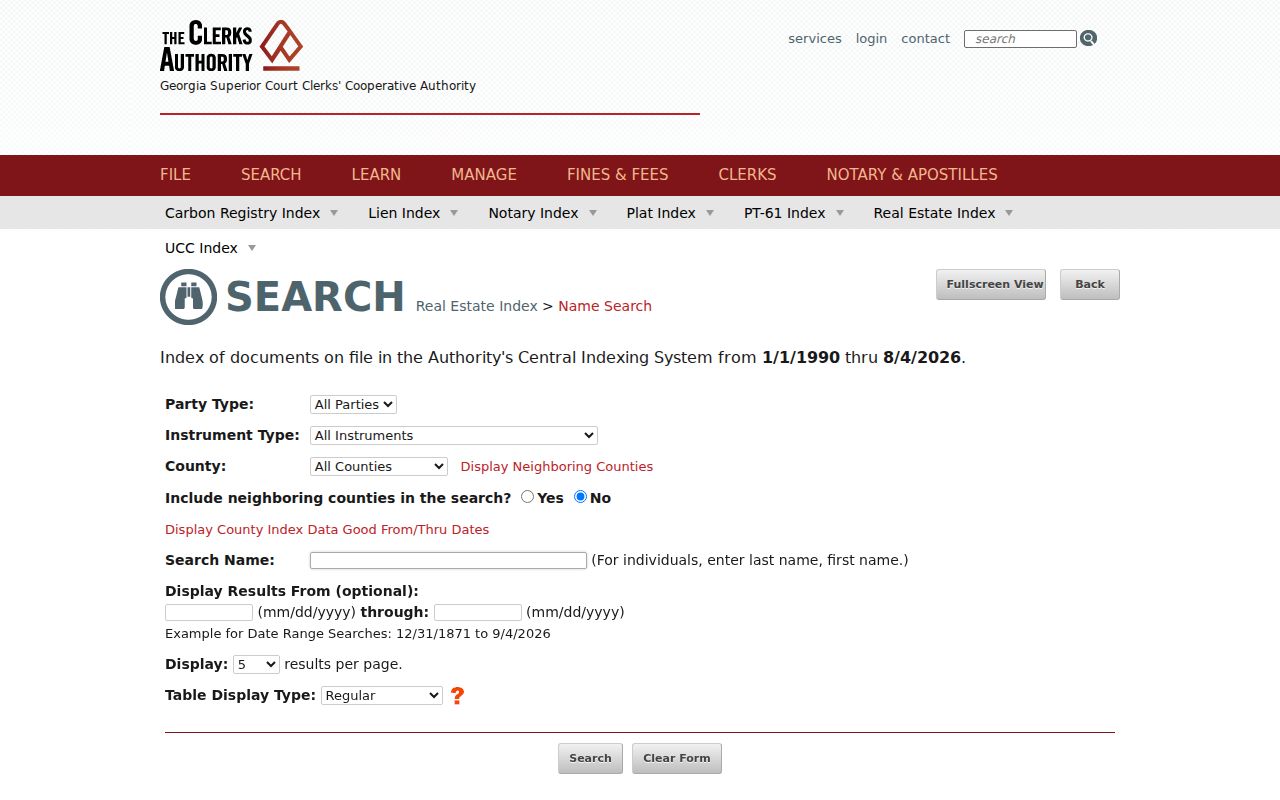
The form shows why county, role, name, date, and instrument selections belong with every saved deed result.
Coffee's Online Deed Depth Ends at the Clerk's Books
The statewide GSCCCA notice lists coverage beginning January 1, 1990. Its learning material says county deed indexes reach back to at least January 1, 1999. Historical data is still being added. Those dates do not guarantee that every Coffee County deed is online. When the index runs dry, bring the last known book and page, legal description, names, and date range straight to the clerk. Elisa C. Gillis, Clerk of Superior Court, works from 101 S. Peterson Avenue, Suite B-18, in Douglas, and the office phone is 912-384-2865. Ask there for the direct and reverse indexes. Ask also for older deed books, public-terminal access, copy rules, and the current coverage date.
Trace Coffee County's Grantor-Grantee Chain
A grantor conveys the stated interest and a grantee takes it. Start with the latest confirmed grantee. Then read that deed for the prior owner and its earlier book-and-page reference. Search that prior owner in both roles across an earlier date range. Keep repeating the pattern until the online index ends. A gap sends you to the clerk's books, a probate file, a plat, or a court record.
- Find the current owner's purchase deed with that party shown as grantee.
- Read the prior owner, legal description, and earlier recording references from the image.
- Search the prior owner as grantee, then repeat with name variants and instrument filters.
- Take the oldest reliable book/page to the clerk when online coverage stops.
- Grantor
- The party conveying the stated interest.
- Grantee
- The party receiving the stated interest.
- Chain of title
- The linked sequence of recorded interests affecting the property.
- Book/page or instrument number
- The clerk reference used to retrieve a record image or certified copy.
Coffee Plat and Lien Windows Need Separate Checks
GSCCCA's coverage tables list Coffee plats from January 1, 1998 through August 31, 2026, and liens from August 4, 2003 through August 25, 2026. Apply neither range to deeds. Search each record family on its own terms, and ask the clerk about earlier books. For a subdivision parcel, compare the deed against the plat and any amendments. For an encumbrance, pair the lien or security deed with its release or satisfaction. Matching names and dates alone never prove two records touch the same parcel.
Plat Record No. 1 Points to an Older Nicholls Chain
A 1916 Coffee County Progress notice described Lots 1, 2, and 3 in Block 87 in Nicholls, platted on a Deen Realty and Improvement Company subdivision map. It cited Coffee County Superior Court Plat Record No. 1, page 50, and Land Lot 514 in the Sixth Land District. That is a precise local lead worth taking to the clerk. The notice proves nothing about current ownership or present boundaries. Pull the plat, follow the later deeds, and compare any replat, right-of-way, easement, or survey that touches the land.
The 1898 and 1938 Fires Complicate Coffee Deed Records
Georgia Archives material documents courthouse record losses in Coffee County in both 1898 and 1938. The 1889 courthouse burned in 1898. The brick courthouse finished in 1900 burned in 1938. Not every old deed vanished in those fires. Even so, no one should assume a clean online chain through either era. Work from surviving clerk books and indexes first. Then turn to Georgia Archives county cards and microfilm. FamilySearch catalog material, probate orders, later deed recitals, plats, tax or sheriff deeds, and Digital Library of Georgia newspapers add further leads. The Douglas-Coffee County Public Library at 200 S. Madison Avenue holds local-history material, newspaper microfilm, and an obituary-clippings file. Every one of these sources offers leads rather than title proof.
Estate and Corrective Instruments Can Repair a Coffee Chain
A deceased owner complicates any deed chain. The instruments that follow may include an executor's deed, administrator's deed, deed of distribution, year's-support order, or court-authorized sale. Meanwhile the assessment roll can still show the decedent. It may carry an "Estate of" label, a fiduciary, or a family trust instead. Note the capacity in which each name appears. A probate appointment grants stated authority, but it does not make the administrator the fee owner.
When an estate interrupts the Coffee County deeds, ask Coffee Probate Court to search by decedent and case number. Request the petition or will, the letters, any authority to sell, the relevant order, and the final disposition as needed. Then search GSCCCA for the estate deed or the recorded order. A marriage record can explain a surname change. It does not convey land. A corrective deed may repair names or descriptions. Read it alongside the original instrument, though, since one without the other can mislead.
Security Deeds, Releases, and Tax Deeds Need a Timeline
Not every filing under an owner's name is a transfer. A security deed records a secured interest only. A cancellation or release may end that interest later. A tax fi fa marks a collection event. A tax deed follows a sale process and may still require redemption or court records to pin down the present interest. Sort the results by instrument type and recording date, then match the legal description.
The online Coffee lien index runs from August 4, 2003 through August 25, 2026. Older liens and releases may sit in clerk books. Ask for the official image whenever an online row is unclear. If a quiet-title, foreclosure, partition, or tax-sale dispute appears, pull the docket and the orders. The clerk or Georgia Courts E-Access can supply them. Pleadings may recite a chain. They remain allegations until an order or a separate recorded instrument establishes the event.
Build a Citation for Every Coffee County Deed
A reliable citation names Coffee County, the grantor and grantee, the instrument type, execution and recording dates, book/page or instrument number, and the exact source viewed. Add the legal description. Include any cross-reference that connects it to the parcel. If the source is only an index, say so. If the image was viewed, state that separately. Later review stays possible even when portal data changes.
When two instruments conflict, preserve both. Keeping both beats forcing a conclusion. Ask the clerk whether a corrective deed, re-recording, cancellation, or later order exists. Legal certainty may require a Georgia title professional. That professional can examine the complete public chain and matters beyond the online index.
Online Access and the Coffee Clerk Terminal Differ
GSCCCA publishes a regular account at $14.95 per calendar month. A $5 single-use account expires after four hours. There is no separate image-view fee. Each printed image page costs $0.50. GSCCCA also states that full access is free at a Superior Court Clerk public terminal. Confirm the current terms before paying.
The terminal matters when an online account is impractical or the public interface does not expose enough detail. Staff can explain the recreated index. Ask how it relates to the official clerk index and how to order the exact image or certification needed.
Obtain a Coffee County Deed Image or Certified Copy
Start with the GSCCCA image. Record the details that matter: Coffee County, the book and page or instrument number, party names, instrument type, and recording date. Those details make any follow-up request easy. If the image is missing, the index conflicts, or the deed predates online coverage, use the public terminal at the clerk's office. You can also call the clerk directly. The clerk can quote current plain-copy and certified-copy charges. Coffee County publishes no separate local fee schedule. A written request works well when you need one specific deed. Identify it by reference, legal description, parties, and date, and keep the scope narrow. The Georgia Open Records Act sets a response window. Agencies generally respond within three business days. Otherwise they give the legal basis and an estimate for delay. For a broader search, ask for a cost estimate first.
Recorded, not guaranteed. Coffee County deed records show indexed filings, not a title opinion. Unrecorded interests, indexing gaps, probate events, and later instruments may affect the result.