
Trace Coffee County Former Owners
The newest deed comes first. Its grantor conveyed an interest. Pull that instrument from the GSCCCA Real Estate Index, and confirm the land description matches the parcel before treating the grantor as a prior owner.
| Source | Years It Covers | Where Held | What It Shows |
|---|---|---|---|
| GSCCCA name index | System evidence from 1990 | Online, then Clerk | Parties, roles, dates, references |
| Older deed books | Before verified online coverage | Coffee Clerk deed room | Earlier recorded transfers |
| Plat index and books | Online Coffee table from 1998 | GSCCCA and Clerk | Subdivision and lot identity |
| Archives and newspapers | Historic leads | Archives, DLG, library | Names and legal-description clues |
Copy every recording date and citation. A recital sometimes cites the earlier deed. When it does not, search the prior grantor as an earlier grantee and compare acreage, district, and plat references against the same parcel. The official GSCCCA book-and-page form opens the direct citation route once the first deed supplies a reference.
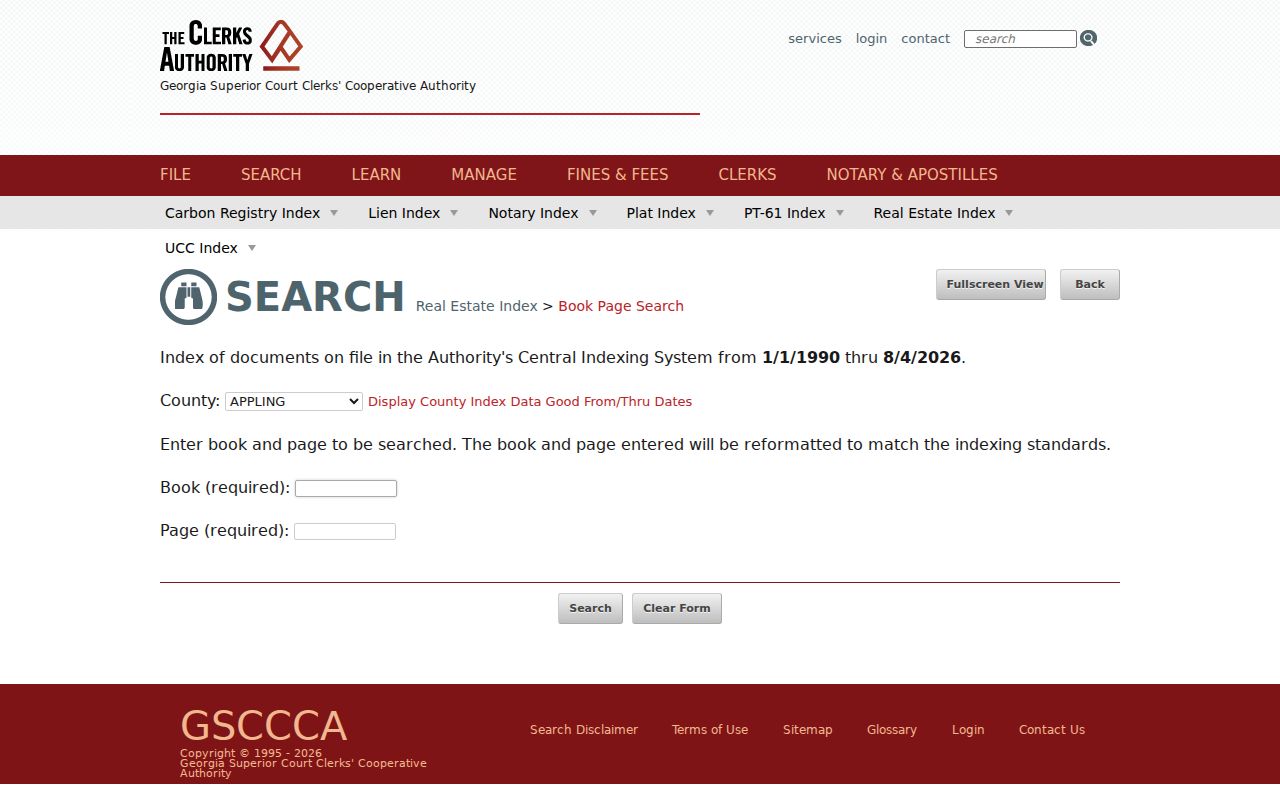
The form turns a citation into a deed image. That image still counts only when its legal description matches the parcel you are chasing.
Coffee’s Online Deed Boundary
Online Coffee deed indexes have limits. Neither posted start date promises full coverage. GSCCAA carries a statewide real-estate notice dated January 1, 1990, its learning material says county deed indexes exist since at least January 1, 1999, and the Clerk can give you the exact beginning and current good-through dates.
Older chain required. Carry the last reliable book/page into the Clerk’s older index when the web trail ends.
Coffee Deed Roles Decoded
Roles keep a backward chain accurate.
- Grantor
- The party conveying an interest.
- Grantee
- The party receiving it.
- Chain of title
- The linked sequence of instruments affecting the land.
- Reverse index
- An index used to trace parties backward.
- Quitclaim deed
- A transfer of whatever interest the grantor holds, without title warranties.
Deeds are not alike. Warranty, quitclaim, tax, administrator's, and corrective instruments each pass something different, so read the image before deciding what a grantor actually conveyed.
Estate Links in Coffee Chains
Death breaks many chains. Probate, trusts, and court-authorized sales can interrupt a neat owner sequence in Coffee County deed records, so search name variants, "Estate of," executor, and administrator terms. A probate order shows authority. A recorded estate deed ties that authority to the parcel, but a fiduciary was not necessarily a beneficial former owner, so preserve the capacity stated in each record.
Reconstruct Coffee Deeds Backward
The method follows one tract through changing names and formats.
- Find the current acquisition deed and copy parties, date, description, and reference.
- Search its grantor as an earlier grantee, allowing name variants.
- Reject hits whose acreage, land district, subdivision, or plat does not fit.
- Repeat, then take the last book/page to the Clerk when online coverage ends.
- Book/page
- The volume and page used to retrieve an older instrument.
- Legal description
- The land identity that survives address changes.
- Recital
- Text in a deed that may cite an earlier transfer.
The Coffee Courthouse Fires
Coffee County lost records twice. Georgia Archives flags record-loss events in 1898 and 1938, and the Digital Library of Georgia logs courthouse fires in both years before the present courthouse was finished in 1940. A missing index entry can mean loss, not silence. Check the surviving books, plats, and tax deeds. The Georgia Archives county cards list microfilm leads that can reconstruct what the fires took.
Nicholls Plat Number One
One 1916 newspaper item names an old plat. The Coffee County Progress described Nicholls Lots 1 through 3, Block 87, on a Deen Realty subdivision map, citing Superior Court plat record no. 1, page 50, in Land Lot 514 of the Sixth Land District. The newspaper notice is only a locator. Retrieve the plat itself. Then pull later deeds, and check the page image because OCR can distort names and numbers.
Coffee Book and Page Bridges
The GSCCCA book/page search wants county, book, and page. It beats a name search once a newer deed, plat, probate order, or legal description hands you an exact cross-reference. Copy the citation exactly. Letters, leading zeros, and instrument distinctions matter.
At the clerk counter, ask for the cited image. Request the surrounding index entry too. Then read the deed for parties, capacity, the land description, and any reference to an earlier instrument. A cross-reference can bridge spelling changes and owners whose names were indexed in odd forms.
GSCCCA says a public terminal at the Superior Court Clerk offers full access with no subscription fee. Online images and printing follow separate rules. Courthouse work continues even when an account limit blocks a web search.
Library Leads for Previous Owners
Coffee County's public library is in Douglas. The Georgia Public Library Service lists it at 200 S. Madison Avenue, Suite D, Douglas, with phone 912-384-4667. Its genealogy collection holds early local-history material, newspaper microfilm, and obituary clippings. A death date, old road name, business name, or sheriff-sale notice found there can lead straight into a deed search.
Ask about city directories too. Reverse directories, cemetery surveys, maps, and vertical files may also be on hand, though the official guide does not list exact directory years. Treat every item as a finding aid. The Clerk's deed or plat settles it.
How Far Coffee Ownership Goes
Deep chains need more tools. Older Coffee County former owners can send you to the Clerk's deed room, Georgia Archives microfilm, the FamilySearch catalog's 1891 land-ownership map lead, and Digital Library of Georgia newspapers. The Douglas-Coffee County Public Library helps too. Its local-history material, newspaper microfilm, and obituary clippings matter most when a chain runs into a death or an old street name.
Lawful use. Former-owner records support house history, estate work, and title research. Never use them to track, harass, threaten, or harm a living person.
The Clerk of Court at 101 S. Peterson Avenue, Suite B-18, Douglas, reachable at 912-384-2865, holds the final word on coverage and on access to older books. For every step in a chain, cite the county, the parties, the instrument type, the recording date, and the book and page. That citation habit keeps a trail others can follow.
Old addresses fail often. Streets get renamed, numbers change, and whole roads vanish. When that happens, lean on the deed language itself. Land lot, district, subdivision, block, lot, metes-and-bounds calls, roads, creeks, and adjoining owners can survive long after a street name has been replaced. Ask the Assessor whether alternate or prior address fields exist for the parcel. Then ask the Clerk to pull instruments recorded under the unchanged legal description. Never force an old tract into a modern street address unless a recorded document ties the two together.
A damaged chain sometimes heals on its own. A later deed may repeat an earlier legal description or cite a book that has gone missing, preserving a link that seemed lost. Tax deeds, sheriff deeds, estate deeds, plats, and court orders can all supply cross-references too. Each one is evidence, with limits. A newspaper advertisement might suggest a sale and a description, but only the recorded result proves whether, and how, an interest actually passed.
Surnames alone rarely carry an older Coffee County chain. Pull the legal description from every instrument instead. Note the subdivision, lot, block, land lot, district, acreage, metes-and-bounds calls, and adjoining owners. One 1916 Nicholls notice names Deen Realty and Improvement Company as the owner of Block 87, Lots 1 through 3. The reference cites Plat Record No. 1 at page 50, Land Lot 514, Sixth District. A chain can break at a changed road name or a misspelled owner. Those details often rejoin it. Treat the newspaper only as a lead until recorded documents confirm it.
Probate and court files explain many breaks between prior owners. A fiduciary often stands between a decedent and the next grantee. Watch for an executor's deed, an administrator's deed, a recorded order, or an estate reference. Keep each person's capacity in the timeline. When the deed points to probate, pull the Coffee County probate or court file. The order gives context. The later recorded conveyance takes its own place in the land-record chain.
Handle fire-era gaps honestly. State the gap rather than inventing a transfer. Lean on the last surviving book and page. Georgia Archives county cards help too. So do surviving clerk indexes, plats, probate material, sheriff-sale notices, and historic newspapers. Note which source produced each name and date. Label every link as documented, probable, or unresolved. Later title work then starts where the record actually stops.